Bonjour!


Welcome to our blog, beautiful . Drop nice words here. Follow us okay? :D.
Thank you !
Tagboard

Visit dem'
The Mastermind
math jokes


.jpg)

Math riddles :)
1. One hundred hats
A prison guard tells his 100 prisoners that they will be playing the following game. The guard will line up the prisoners single-file, all facing the front of the line. The guard will place a red or a black hat on each prisoner’s head. There could be any combination of red and black hats (perhaps 50 and 50, perhaps 99 and 1, perhaps 100 and 0, etc.) and the hats could be in any order. Each prisoner can only see the hats of those in front of him in line, and not his own hat or those hats behind him. The guard will start with the prisoner at the end of the line (who can see all hats except his own), and ask “Is your hat red or black?”. If the prisoner responds correctly, he will be set free. Otherwise he will remain in jail. The guard will then ask the second to last prisoner in line the same question, with the same consequences. The guard will keep moving forward, asking the same question, until all 100 prisoners have been asked. Before the guard begins the game, the prisoners are allowed to devise a strategy. Once the game begins, the prisoners cannot communicate, except by answering “red” or “black” in response to the guard. They can’t use volume, intonation, or pauses in their response to communicate, as the guard will notice all these tricks (it’s a math riddle). Your task is to devise a strategy so that at most one prisoner remains in jail, and so that at least 99 prisoners are set free. How do you do it?
2. Three hats
There are 3 prisoners in a room. Two are wearing red hats, and one is wearing black hat. Each prisoner can see all hat colors except his own. The prison guard tells them, “Each of you is wearing a red or a black hat. Tell me your hat color, and you will be set free.” Since none of the prisoners can see their own hat, nobody responds. Next the guard adds, “At least one person is wearing a red hat.” Soon afterwards, a prisoner correctly identifies his hat color. How?
3. Tiling a chess board
(Part I) Cover the top right and bottom left squares of an 8 × 8 chessboard. Can you tile the remaining 62 squares with 31 tiles of size 2 × 1?
(Part II) Cover any 3 corner squares of a 30 × 30 board. Can you tile the remaining 897 squares with 299 tiles of size 3 × 1?
4. One hundred quarters
There are 100 quarters lying flat on a table. Twenty have heads facing up and the rest show tails. You are blindfolded and gloved so that you cannot see or feel which are are heads and which are tails. You are allowed to pick up and move the quarters however you like, but at the end of your manipulations each of the 100 quarters must be showing either heads or tails. Your task is to split the 100 quarters into two groups that are guaranteed to have the same number of heads facing up. How do you do it?
I'm so sorry if you cant find the answers..
-NIK-
A prison guard tells his 100 prisoners that they will be playing the following game. The guard will line up the prisoners single-file, all facing the front of the line. The guard will place a red or a black hat on each prisoner’s head. There could be any combination of red and black hats (perhaps 50 and 50, perhaps 99 and 1, perhaps 100 and 0, etc.) and the hats could be in any order. Each prisoner can only see the hats of those in front of him in line, and not his own hat or those hats behind him. The guard will start with the prisoner at the end of the line (who can see all hats except his own), and ask “Is your hat red or black?”. If the prisoner responds correctly, he will be set free. Otherwise he will remain in jail. The guard will then ask the second to last prisoner in line the same question, with the same consequences. The guard will keep moving forward, asking the same question, until all 100 prisoners have been asked. Before the guard begins the game, the prisoners are allowed to devise a strategy. Once the game begins, the prisoners cannot communicate, except by answering “red” or “black” in response to the guard. They can’t use volume, intonation, or pauses in their response to communicate, as the guard will notice all these tricks (it’s a math riddle). Your task is to devise a strategy so that at most one prisoner remains in jail, and so that at least 99 prisoners are set free. How do you do it?
2. Three hats
There are 3 prisoners in a room. Two are wearing red hats, and one is wearing black hat. Each prisoner can see all hat colors except his own. The prison guard tells them, “Each of you is wearing a red or a black hat. Tell me your hat color, and you will be set free.” Since none of the prisoners can see their own hat, nobody responds. Next the guard adds, “At least one person is wearing a red hat.” Soon afterwards, a prisoner correctly identifies his hat color. How?
3. Tiling a chess board
(Part I) Cover the top right and bottom left squares of an 8 × 8 chessboard. Can you tile the remaining 62 squares with 31 tiles of size 2 × 1?
(Part II) Cover any 3 corner squares of a 30 × 30 board. Can you tile the remaining 897 squares with 299 tiles of size 3 × 1?
4. One hundred quarters
There are 100 quarters lying flat on a table. Twenty have heads facing up and the rest show tails. You are blindfolded and gloved so that you cannot see or feel which are are heads and which are tails. You are allowed to pick up and move the quarters however you like, but at the end of your manipulations each of the 100 quarters must be showing either heads or tails. Your task is to split the 100 quarters into two groups that are guaranteed to have the same number of heads facing up. How do you do it?
I'm so sorry if you cant find the answers..
-NIK-
Top 10 Greatest Mathematicians

Greek Mathematician
Pythagoras is considered by some to be one of the first great mathematicians.
Living around 570 to 495 BC, in modern day Greece, he is known to have founded
the Pythagorean cult, who were noted by Aristotle to be one of the first groups
to actively study and advance mathematics. He is also commonly credited with
the Pythagorean Theorem within trigonometry. However, some sources doubt that
is was him who constructed the proof (Some attribute it to his students, or
Baudhayana, who lived some 300 years earlier in India). Nonetheless, the effect
of such, as with large portions of fundamental mathematics, is commonly felt
today, with the theorem playing a large part in modern measurements and
technological equipment, as well as being the base of a large portion of other
areas and theorems in mathematics. But, unlike most ancient theories, it played
a bearing on the development of geometry, as well as opening the door to the
study of mathematics as a worthwhile endeavor. Thus, he could be called the
founding father of modern mathematics.
9.Andrew Wiles

The only currently
living mathematician on this list, Andrew Wiles is most well known for his
proof of Fermat’s Last Theorem: That no positive integers, a, b and c can
satisfy the equation a^n+b^n=c^n For n greater then 2. (If n=2 it is the
Pythagoras Formula). Although the contributions to math are not, perhaps, as
grand as other on this list, he did ‘invent’ large portions of new mathematics
for his proof of the theorem. Besides, his dedication is often admired by most,
as he quite literally shut himself away for 7 years to formulate a solution.
When it was found that the solution contained an error, he returned to solitude
for a further year before the solution was accepted. To put in perspective how
ground breaking and new the math was, it had been said that you could count the
number of mathematicians in the world on one hand who, at the time, could
understand and validate his proof. Nonetheless, the effects of such are likely
to only increase as time passes (and more and more people can understand it).

I have placed these two
together as they are both often given the honor of being the ‘inventor’ of
modern infinitesimal calculus, and as such have both made monolithic
contributions to the field. To start, Leibniz is often given the credit for
introducing modern standard notation, notably the integral sign. He made large
contributions to the field of Topology. Whereas all round genius Isaac Newton
has, because of the grand scientific epic Principia, generally become the
primary man hailed by most to be the actual inventor of calculus. Nonetheless,
what can be said is that both men made considerable vast contributions in their
own manner.

Blgollo, also known as
Leonardo Fibonacci, is perhaps one of the middle ages greatest mathematicians.
Living from 1170 to 1250, he is best known for introducing the infamous
Fibonacci Series to the western world. Although known to Indian mathematicians
since approximately 200 BC, it was, nonetheless, a truly insightful sequence,
appearing in biological systems frequently. In addition, from this Fibonacci
also contributed greatly to the introduction of the Arabic numbering system.
Something he is often forgotten for.
Haven spent a large
portion of his childhood within North Africa he learned the Arabic numbering
system, and upon realizing it was far simpler and more efficient then the bulky
Roman numerals, decided to travel the Arab world learning from the leading
mathematicians of the day. Upon returning to Italy in 1202, he published his
Liber Abaci, whereupon the Arabic numbers were introduced and applied to many
world situations to further advocate their use. As a result of his work the
system was gradually adopted and today he is considered a major player in the
development of modern mathematics.

After the end of the war
he invested his time in computing. Having come up with idea of a computing
style machine before the war, he is considered one of the first true computer
scientists. Furthermore, he wrote a range of brilliant papers on the subject of
computing that are still relevant today, notably on Artificial Intelligence, on
which he developed the Turing test which is still used to evaluate a computers
‘intelligence’. Remarkably, he began in 1948 working with D. G. Champernowne,
an undergraduate acquaintance on a computer chess program for a machine not yet
in existence. He would play the ‘part’ of the machine in testing such programs.

French Philosopher,
Physicist and Mathematician Rene Descartes is best known for his ‘Cogito Ergo
Sum’ philosophy. Despite this, the Frenchman, who lived 1596 to 1650, made
ground breaking contributions to mathematics. Alongside Newton and Leibniz,
Descartes helped provide the foundations of modern calculus (which Newton and
Leibniz later built upon), which in itself had great bearing on the modern day
field. Alongside this, and perhaps more familiar to the reader, is his
development of Cartesian Geometry, known to most as the standard graph (Square
grid lines, x and y axis, etc.) and its use of algebra to describe the various
locations on such. Before this most geometers used plain paper (or another
material or surface) to preform their art. Previously, such distances had to be
measured literally, or scaled. With the introduction of Cartesian Geometry this
changed dramatically, points could now be expressed as points on a graph, and
as such, graphs could be drawn to any scale, also these points did not necessarily
have to be numbers. The final contribution to the field was his introduction of
superscripts within algebra to express powers. And thus, like many others in
this list, contributed to the development of modern mathematical notation.

Living around 300BC, he
is considered the Father of Geometry and his magnum opus: Elements, is one the
greatest mathematical works in history, with its being in use in education up
until the 20th century. Unfortunately, very little is known about his life, and
what exists was written long after his presumed death. Nonetheless, Euclid is
credited with the instruction of the rigorous, logical proof for theorems and
conjectures. Such a framework is still used to this day, and thus, arguably, he
has had the greatest influence of all mathematicians on this list. Alongside
his Elements were five other surviving works, thought to have been written by
him, all generally on the topic of Geometry or Number theory. There are also
another five works that have, sadly, been lost throughout history.

Bernhard Riemann, born
to a poor family in 1826, would rise to become one of the worlds prominent
mathematicians in the 19th Century. The list of contributions to geometry are
large, and he has a wide range of theorems bearing his name. To name just a
few: Riemannian Geometry, Riemannian Surfaces and the Riemann Integral.
However, he is perhaps most famous (or infamous) for his legendarily difficult
Riemann Hypothesis; an extremely complex problem on the matter of the
distributions of prime numbers. Largely ignored for the first 50 years
following its appearance, due to few other mathematicians actually
understanding his work at the time, it has quickly risen to become one of the
greatest open questions in modern science, baffling and confounding even the
greatest mathematicians. Although progress has been made, its has been
incredibly slow. However, a prize of $1 million has been offered from the Clay
Maths Institute for a proof, and one would almost undoubtedly receive a Fields
medal if under 40 (The Nobel prize of mathematics). The fallout from such a
proof is hypothesized to be large: Major encryption systems are thought to be
breakable with such a proof, and all that rely on them would collapse. As well
as this, a proof of the hypothesis is expected to use ‘new mathematics’. It
would seem that, even in death, Riemann’s work may still pave the way for new
contributions to the field, just as he did in life.

Child prodigy Gauss, the
‘Prince of Mathematics’, made his first major discovery whilst still a
teenager, and wrote the incredible Disquisitiones Arithmeticae, his magnum
opus, by the time he was 21. Many know Gauss for his outstanding mental ability
– quoted to have added the numbers 1 to 100 within seconds whilst attending primary
school (with the aid of a clever trick). The local Duke, recognizing his
talent, sent him to Collegium Carolinum before he left for Gottingen (at the
time it was the most prestigious mathematical university in the world, with
many of the best attending). After graduating in 1798 (at the age of 22), he
began to make several important contributions in major areas of mathematics,
most notably number theory (especially on Prime numbers). He went on to prove
the fundamental theorem of algebra, and introduced the Gaussian gravitational
constant in physics, as well as much more – all this before he was 24! Needless
to say, he continued his work up until his death at the age of 77, and had made
major advances in the field which have echoed down through time.

If Gauss is the Prince,
Euler is the King. Living from 1707 to 1783, he is regarded as the greatest
mathematician to have ever walked this planet. It is said that all mathematical
formulas are named after the next person after Euler to discover them. In his
day he was ground breaking and on par with Einstein in genius. His primary (if
that’s possible) contribution to the field is with the introduction of
mathematical notation including the concept of a function (and how it is
written as f(x)), shorthand trigonometric functions, the ‘e’ for the base of
the natural logarithm (The Euler Constant), the Greek letter Sigma for
summation and the letter ‘/i’ for imaginary units, as well as the symbol pi for
the ratio of a circles circumference to its diameter. All of which play a huge
bearing on modern mathematics, from the every day to the incredibly complex.
As well as this, he also
solved the Seven Bridges of Koenigsberg problem in graph theory, found the
Euler Characteristic for connecting the number of vertices, edges and faces of
an object, and (dis)proved many well known theories, too many to list.
Furthermore, he continued to develop calculus, topology, number theory,
analysis and graph theory as well as much, much more – and ultimately he paved
the way for modern mathematics and all its revelations. It is probably no
coincidence that industry and technological developments rapidly increased
around this time.
posted by:aisyah :)
math poem

posted by :hajar
chapter 5:The straight line

history of mathematics
Standard Form (Video Tutorial and Quiz)
Watch the video by Chegu Selva below for a tutorial on how to answer Standard Form questions from Chapter One Form Four Mathematics.
Now that you've understood the sub-topic of Chapter One, test your understanding by trying out the following questions. Try not to look at the answers until after you're done answering or if you don't know how to do the questions. Good luck!
1. Express the following in Standard Form:
(a) 667500 = ....................
(b) 5460 = ....................
(c) 0.0541 = ....................
(d) 0.00088 = ...................
2. Change the following into normal numbers:
(a) 5.5 x 10-7 = ....................
(b) 1.76 x 105 = ....................
(c) 3.955 x 10-2 = ....................
(a) 5.5 x 10-7 = ....................
(b) 1.76 x 105 = ....................
(c) 3.955 x 10-2 = ....................
Answers: 1 (a) 6.675 x 10
2 (a) 0.00000055 (b) 176000 (c) 0.03955
Mathematic Jokes ☺

- When a student asked her grandmother for help "finding the least common denominator" the grandmother replied, "You mean they haven't found that yet. They were looking for it when I was in school."
- What does a mathematician call the occupied restroom on an airplane? .... (A hy-pot-en-use)
- What does a bull add with? .... (a cow-cu-lator)
- What do mathematicians sleep on? .... (ma-trices)
- What does a dentist scrape from your teeth? .... (calculus)
- What do you do with yarn and a needle? .... (u-nit)
- What do you call a sunburned man? .... (a tan-gent)
- What kind of insect is good at math? .... (an account-ant)
- How do you make seven even? .... (take away the "s")
- Why did the student eat his math exam?
- .... (because the teacher said that it was "a piece of cake")
- Old mathematicians never die, they just lose some of their functions.
ⓈⓊⒽ✿ⓎⒺⒶⓃⒼ
Why should we learn maths?
Math helps us to identify patterns and relationships. Two things that may at first glance appear very different, may turn out to be mathematically very similar.
Math helps us keep score - not just in sports, but in everything that we measure: time, distance, money, cooking quantities, building materials, etc.
Math helps us make better choices: Is the economy size of toothpaste really worth it? How much highway driving makes a hybrid car a better value?
Sometimes math helps us make the best choice. Is there a way to use the least amount of fencing to cover a certain area?
Math helps us decide whether the conclusions of polls are reasonable or not. If someone tells you that "Three out of four college students prefer Whompers" - do they really?
Math is crucial in the natural sciences like physics and chemistry, but it is also important in the social sciences such as economics and sociology. Most college majors require at least some mathematics. Limiting the math that you study may limit your career options.
Math has connections to subjects where you might not expect it - art, music, and poetry are a few. Did Shakespeare really write all the plays commonly attributed to him - mathematicians have attempted to answer this.
If you are in school now, you may live for another fifty years, or more. Technology is changing so rapidly, and no one can predict the skills that people will need in the workplace or at home in the coming years. Most math teachers would be willing to bet that you will be better prepared for the future by getting a good background in math.
Math can be fun. Just as we play games, do crossword puzzles, and read mysteries for fun, math shares characteristics with all of these.
What if the electric cash register stops working at the store? You still have to make change.
Quotes


By: Joy Chong
MATHEMATICS POEM.
A Maths Poem
by Andrew N.
Is it a decimal or is it a fraction,
Should I divide or use subtraction?
Can anyone tell me what is this shape,
Do we use a ruler or maybe a tape?
One hundred centimetres make one metre,
How many millilitres to a litre?
Push the buttons on a calculator,
Teacher shouts 'Use your brains!' - you'll need them later.
Three times six, find the factor,
(But not using a protractor)
Posted by Brinda Menon
The Cube
''We turn the Cube and it twists us.'' -Erno Rubik
The Rubiks Cube is a cube consisting of 6 sides with 9 individual pieces on each. The main objective when using one is to recreate it's original position, a solid color for each side, with out removing any piece from the cube. Though it is colorful and looks like a children's toy, there have been many championships for it's completion. It amused five- year-olds yet inspired mathematicians.
It's unique design was made by an engineer named Erno Rubik, a socialist bureaucrat who lived in Budapest, Hungary. He built the simple toy in his mother's apartment and did not know of the 500 million people who were going to become overly perplexed over it. His first idea of the cube came in the Spring of 1974.
What inspired Erno was the popular puzzle before his called the 15 Puzzle. Invented in the late 1870's, this puzzle consisted of 15 consecutively numbered, flat squares that can be slid around inside a square frame. Sam Loyd created this two dimensional version of the Rubiks Cube. The puzzle was originally called the Magic Cube, or Buvuos Kocka in Hungarian. It was later renamed in honor of it's creator to the Rubiks Cube. Many different cube variations have been made, but the one discussed here is called the standard 3x3x3. It contains 26 little blocks of plastic.
The Rubiks Cube has been a successful product for many years. Though created without great intentions, people have spent millions of dollars on it. Math classes to this day study the complexity of the Cube. Erno, the creator of the cube, became an overly rich man from his ingenious creation.
Read more?
The Rubiks Cube is a cube consisting of 6 sides with 9 individual pieces on each. The main objective when using one is to recreate it's original position, a solid color for each side, with out removing any piece from the cube. Though it is colorful and looks like a children's toy, there have been many championships for it's completion. It amused five- year-olds yet inspired mathematicians.
It's unique design was made by an engineer named Erno Rubik, a socialist bureaucrat who lived in Budapest, Hungary. He built the simple toy in his mother's apartment and did not know of the 500 million people who were going to become overly perplexed over it. His first idea of the cube came in the Spring of 1974.
What inspired Erno was the popular puzzle before his called the 15 Puzzle. Invented in the late 1870's, this puzzle consisted of 15 consecutively numbered, flat squares that can be slid around inside a square frame. Sam Loyd created this two dimensional version of the Rubiks Cube. The puzzle was originally called the Magic Cube, or Buvuos Kocka in Hungarian. It was later renamed in honor of it's creator to the Rubiks Cube. Many different cube variations have been made, but the one discussed here is called the standard 3x3x3. It contains 26 little blocks of plastic.
The Rubiks Cube has been a successful product for many years. Though created without great intentions, people have spent millions of dollars on it. Math classes to this day study the complexity of the Cube. Erno, the creator of the cube, became an overly rich man from his ingenious creation.
Read more?
Posted by Nuwai
Who made the calculator?
 |
| Image edited and made by Sofiah Shariman, 2013 |
The idea that Pascal left behind would eventually be picked up byGottfried Leibniz. With a few improvements, he would add a number of different features to the device, putting in an addition, subtraction, multiplication, and even a divide button so there would be something here for all to use in order to solve some really hard problems. Later on another man named John Napier would invent another aspect to the calculator to be used. This new aspect was a multiplication based table that would make use of metal rods simply called “Napier’s Bones” in order to make the extra work involved in the multiplication tables better for everyone to use.
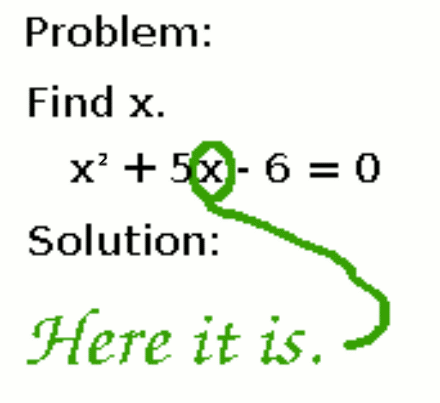
chapter 2 : QUADRATIC EQUATIONS
1. Factorization method
Applied mathematics
Applied mathematics concerns itself with mathematical methods that are typically used in science, engineering, business, and industry. Thus, "applied mathematics" is amathematical science with specialized knowledge. The term applied mathematics also describes the professional specialty in which mathematicians work on practical problems; as a profession focused on practical problems, applied mathematics focuses on the "formulation, study, and use of mathematical models" in science, engineering, and other areas of mathematical practice.
In the past, practical applications have motivated the development of mathematical theories, which then became the subject of study in pure mathematics, where mathematics is developed primarily for its own sake. Thus, the activity of applied mathematics is vitally connected with research in pure mathematics.
Statistics and other decision sciences
Applied mathematics has significant overlap with the discipline of statistics, whose theory is formulated mathematically, especially with probability theory. Statisticians (working as part of a research project) "create data that makes sense" with random sampling and with randomized experiments;the design of a statistical sample or experiment specifies the analysis of the data (before the data be available). When reconsidering data from experiments and samples or when analyzing data from observational studies, statisticians "make sense of the data" using the art of modelling and the theory of inference – with model selection and estimation; the estimated models and consequential predictions should be tested on new data.
Statistical theory studies decision problems such as minimizing the risk (expected loss) of a statistical action, such as using a procedure in, for example, parameter estimation,hypothesis testing, and selecting the best. In these traditional areas of mathematical statistics, a statistical-decision problem is formulated by minimizing an objective function, like expected loss or cost, under specific constraints: For example, designing a survey often involves minimizing the cost of estimating a population mean with a given level of confidence.Because of its use of optimization, the mathematical theory of statistics shares concerns with other decision sciences, such as operations research, control theory, and mathematical economics.
Computational mathematics
Computational mathematics proposes and studies methods for solving mathematical problems that are typically too large for human numerical capacity. Numerical analysis studies methods for problems in analysis using functional analysis and approximation theory; numerical analysis includes the study of approximation and discretization broadly with special concern for rounding errors. Numerical analysis and, more broadly, scientific computing also study non-analytic topics of mathematical science, especially algorithmicmatrix and graph theory. Other areas of computational mathematics include computer algebra and symbolic computation.
kelly***
 We created this blog
 Nurul Hayati
  Nor Shazrina
  Aina Nuraina
  Siti Ailya Hanum
  Hani Inessa
  Nurul Syahirah
  Monaliza
  Ngan Suh Yeang
  Demi Tan
  Kelly
Kelly  Thanaletchumi
 Noor Hamizah
 Brinda Menon
  Damilia Othman
  Zainab Sofiah
  Siti Hajar
  Suraya Nazimah
  Siti Aisyah
  Kavita
  Mun Yan
  Nik Alyssa
  Nuwairah
  Samantha
  Joy Chong
  Dharsilla Nisa
 Deliza
 Renisha


 All entries are posted by 4KNners 2013.

